Tuesday, March 12, 2024

WHEN WE WERE ULTRA: Punked By A Green-And-Purple Sci-Fi Cockroach and Other Indignities (RUNE V. 2, RUNE V. VENOM, RUNE: HEARTS OF DARKNESS, RUNE/CONAN crossover event)

 As with the other three Ultraverse titles that netted itself a second volume, changes were very apparent in the new, post-Black September Rune.  While Kyle Hotz was retained as the artist of note, the scripting was taken over by Len Kaminski, perhaps best known for the run on Iron Man that introduced War Machine*.  The reboot changes of the second volume did manage to make the plotline more comprehensible than it was in volume one.  However, it doesn't necessarily make it better.

At the end of Rune Infinity, Rune is literally dumped into the Negative Zone, where he will get owned rather decisively by Annihilus (incidentally, one of my favorite Marvel baddies).  This leaves us with the two twins who made up Gemini, Erik and Noel.  As Erik is bitten and turned by Rune in the Curse of Rune mini, he takes over the Gemini form at night and stalks Los Angeles whereas Noel has control of the body during the day and tries to be humanity's savior while totally misunderstanding how to do so.  Meanwhile, Adam Warlock (who we found at the end of Curse) is revived by Aladdin, gains healing powers and sort of walks around, reviving the people seriously injured by Noel's 'world saving.'  And in the background, instead of Janus, we've got a pair of police detectives and a policewoman who's secretly a bewinged and befeathered ultra that Warlock takes an interest in.

Don't worry, though--Rune gets a two part tale set during the Black Plague in issues #4-5 before finally finding his way out of the Negative Zone into Marvel Earth and fusing with a symbiote (where did he get a symbiote?  Hell if I know...) so he can tangle with Venom in the appropriately named Rune Vs. Venom one-shot.  He doesn't appear in the last two issues of Volume Two, but does show up in both the Rune: Heart of Darkness mini and the rather unique crossover with Conan.

The good news is Len Kaminski's stories are more coherent and focused than what we saw in Volume One.  The bad news is it's still a mess and a half.  It's hurt by the fact that both Erik and Noel become absolutely unsympathetic and unlikeable over the course of the first three issues of volume two.  By the time we do hit that Rune flashback two-parter--also a lot more coherent and focused than the first volume--it's almost a relief.  

Then there's the presence of Adam Warlock.  I think he's brought in to act as an opponent for our Gemini/Rune Jr. mash-up, something that's given more credence by his being given the new ability to 'travel through men's souls' and heal, maybe even from death, others.  But he hangs out with Aladdin for two issues, all the while moaning about being brought back to life again, wanders into Los Angeles and hangs out with an ultrafied cop with wings....it's made obvious there's a Big Conflict between the two coming.  But when they're finally face to face, on the last page of the last issue of Volume Two, we're directed to the first issue of Ultraverse Unlimited for the resolution (and I'm so unimpressed that I'll wait to talk about that when we get to that title as a whole).

So volume two leads into Rune: Heart of Darkness, written by Doug Moench with pencils by Kyle Hotz.  This finds Rune in New York being hunted by a malign intelligence that, we learn in flashback, is where Rune got his soul-sucking gems from.  This really seems like an attempt to realign the character into a more 'heroic' role.  After two and a half issues of running around, Rune ends up winning the battle by getting the rune gems on his side by promising only to sup on the wicked.  It's great seeing Hotz work on a character that's right up his alley--Hotz leaves midway through volume two, presumably to do this--but there's something weird about how Rune went from The Big Bad of The Ultraverse to Cosplay Morbius in his last appearance.

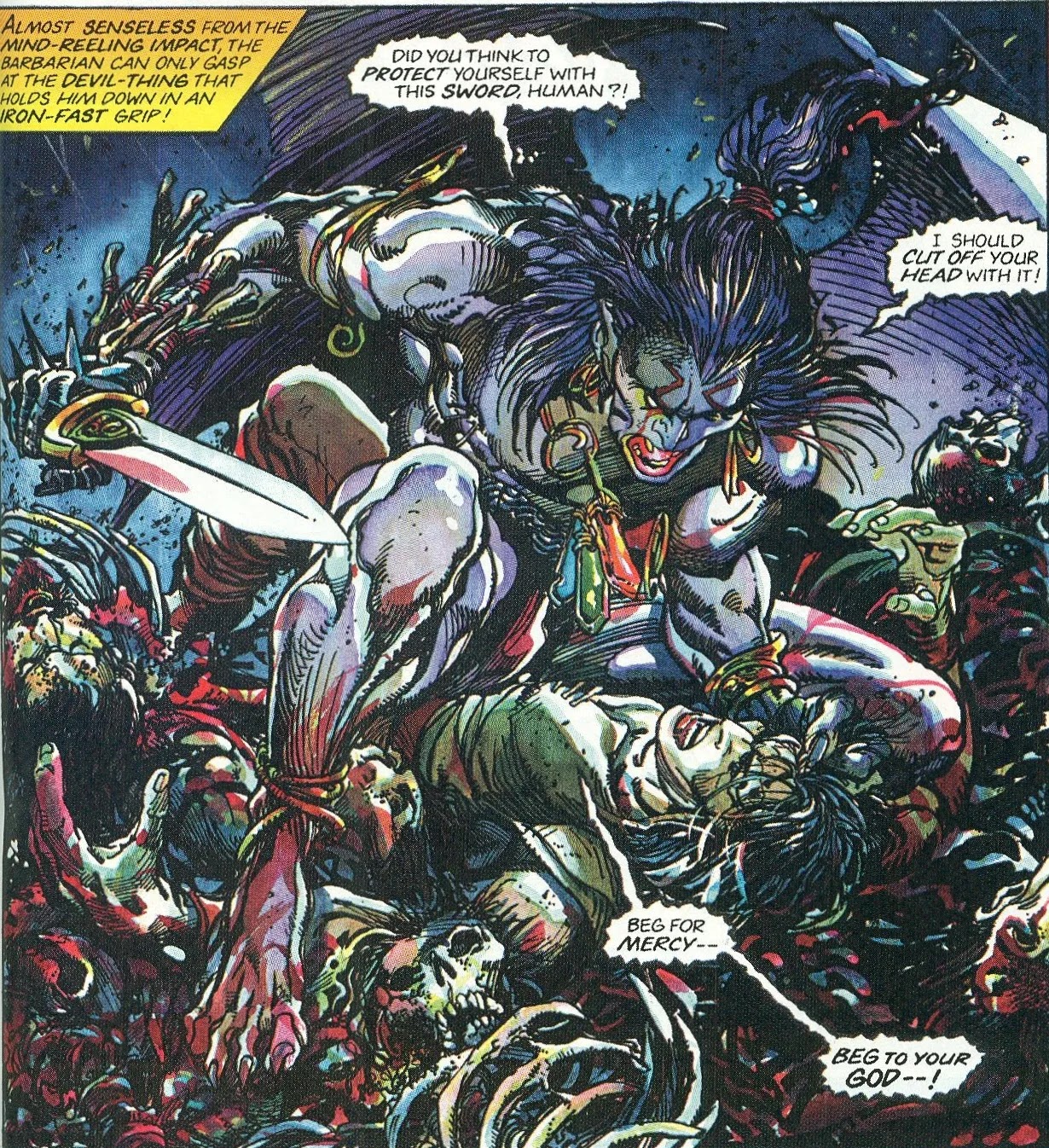
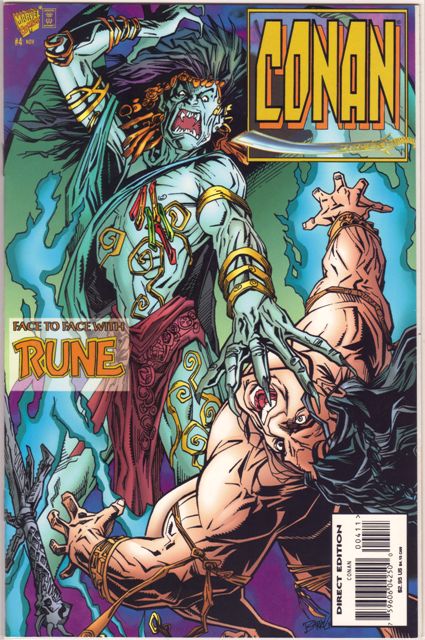
The funniest thing is that the outlier to this phase of the Ultraverse--the only Marvel/Ultraverse crossover that's put out by Marvel--is arguably the best thing published featuring the character.  To celebrate Barry Windsor Smith's debut on Conan twenty five years previously, Marvel editor Carl Potts arranged for an event called Rune v. Conan.  This took up the fourth issues of both Conan The Barbarian and the black-and-white The Savage Conan as well as a stand alone special.  Cleverly, the event is portrayed as happening over the life of Conan with each issue focusing on a different phase of his career.  All three of these could be read on their own to get a complete story, but reading them together gives you a different reading experience.  Each issue is great for its own reason.  Larry Hama provides the script for Conan, and it's a massively breathless adventure story full of swashing and buckling with Rune in the background getting visions of Conan as his greatest opponent.  The special, written and drawn by Windsor Smith, shows the character at his best as young Conan stumbles upon Rune supping on an entire troupe and fight very, very hard to gain even a sliver of vengeance.  And The Savage Conan issue shows us the two encounter each other while Conan is King as a priest tries to call forth a Lovecraftian monster.

Which brings me to something that puzzled me.  Considering that the best stories featuring Rune (the prequel serial, the two-part story set during the Middle Ages, the Conan crossover) were those dealing in the past, why wasn't that the premise of the series?  The Ultraverse had a number of characters and concepts that stretched back into the past, and I'd be intrigued to see Rune interact with, let's say, Rex Mundi or Rhiannon or Lukacz earlier in their existence, or following up on some of the hints in the prequel (why did Rune pick Tesla's mind anyway?).  We could even do stories on some of the individuals who became trapped in Rune's stones.  Ultimately, I don't think the tight interconnectivity hurt the concept--it just needed a little thought to make it work optimally.  Rune doesn't work as The Cosmic Big Bad, but he definitely could have worked to further build the 'world' of the Ultraverse.

I once again state--I wanted to like Rune.  And for a change, the second volume suggests to me how I could have liked it.  But taken as a whole, this series was very disappointing.  It's certainly in a lower tier, a book that never lived up to its true potential because...well, maybe because the creative team behind it wanted it to be something else.

And speaking of characters and potential, next time we'll look at the last character introduced before the Black September reboot whose major problem may have been being introduced just as Black September hit...and also maybe the fact that we don't learn her origin until her series is over.   Join me--and Taskmaster, and Diamondback, and yet another kid sidekick--as we kick back and examine the short solo life of Siren!

Until then....why be meta when you can be ultra?

*--although for me, I will always fondly remember him for his year-long arc on Hellstorm, Prince of Lies...complete with frequent swipes at DC's John Constantine: Hellblazer, the title it was consciously aping.


Sunday, March 3, 2024

WHEN WE WERE ULTRA: BUT I WANNA DO COSMICALLY POWERED ALIEN BARBARIAN VAMPIRES WITH CANCER! (RUNE V. 1, THE CURSE OF RUNE, RUNE/SILVER SURFER)

I really, really wanted to like Rune.

I did.  I know that Barry Windsor-Smith can be off-putting to some, but I love his unique pencil style.  The fact that Rune was supposed to be focusing on the Ultraverse's major villain was novel.

But it pains me to say this--what resulted from Windsor-Smith taking a liking to a proposal by Chris Ulm is just, well, impenetrable.  What's worst, it has so little to do with the Ultraverse that it rightfully should have been put under the banner of Bravura, the Malibu Comics imprint for creator-owned properties.

Rune is an ancient...alien?...barbarian who was exiled to Earth by Argus, one of the deities we learn a lot about in the Godwheel event.  While hanging out here, he ends up being vampirized and becomes worshipped as a god by a tribe in Africa.  A war with another tribe causes Rune's girlfriend to be murdered, resulting in him stalking the Earth and getting cancer from a nuclear bomb blast.  Meanwhile, a military man during the Vietnam war discovers an alien artifact and creates an AI called Genie that leads to the foundation of Aladdin and the creation of two boys infused with alien tech that, when joined, become a ultra-powered cosmic being named Gemini.  Meanwhile a fat guy cosplaying as John Constantine with a pet rat called Janus looks for Gemini so he can find Rune and...

sigh

Did everybody get that?

Believe it or not, there's loads more exposition, and even after absorbing it all I still don't understand what Windsor Smith and Ulm is actually talking about.  I will begrudingly admit that the storyline gains a little bit more clarity in the last issue of Volume 1--the first issue where Ulm flies solo and Windsor Smith isn't doing pencils--but at that point Marvel has taken over the reins and things go back to confusing.  The last issue leads us into Godwheel, which then leads us into Rune/Silver Surfer, yet another flipbook with the same story being recounted by the POV of the two different characters.  In that issue, Rune shows up on Marvel Earth just long enough to grab all the Infinity Gems and stop time only for the Silver Surfer to show up and punch him back to the Ultraverse...

...which leads right into the four part Curse of Rune, where Gemini and Janus look for Rune, and Shuriken (remember her from All-New Exiles?  This is her debut) shows up looking to capture Gemini and kill Rune, and Rune shows up and bites Gemini, who is now part vampire, and....

As all knotted up as the storyline is, I would have forgiven it if the characters were, well, interesting, and these characters aren't.  After showing some charisma in the prologue that ran through all the Ultraverse titles (and reprinted as a promotional giveaway in an issue of Spin), Rune spends almost all of his time thumping his chest and giving himself really Edgelord-y nicknames like 'The Dark God' and 'Prince of The Void.'  The only way I can tell the difference between the two kids who make up Gemini is because one of them is always whining about his girlfriend.  And Janus...oh, god, Janus.  There's a constant sense that Janus will be Really Important, and that there's a reason he's hunting Rune and that he's older and more powerful than his 'scraggly homeless man' vibe indicates...but nothing connected to him ever develops.  At one point, this is a character who is decapitated and his head put on a pike that still talks and I felt nothing.  I wasn't impressed, I wasn't sickened, I wasn't disgusted or disgruntled...not. A. Thing.

This series just made my head hurt.  And throughout it all, I never got a sense it actually belonged in the Ultraverse.  Outside of the issue where Mantra and Prime show up for a couple of pages and the Aladdin name, it felt like it was happening in its own continuity.  I wonder if I would find this more palatable if this was a stand-alone series (and let's be obvious, Bravura was right there).  But since Rune was a much-touted Ultraverse title set in the Ultraverse, I have to evaluate it in the context of the imprint.  And as part of the imprint, the story fails. I think Malibu knew it also judging by the way there was a sudden, sharp pivot to defining Lord Pumpkin and Necromantra as the major bads of the continuity.

At least the art, more often than not, is spectacular.  In addition to Windsor Smith the majority of the first volume, we get lovely John  Buscema pencils on the Silver Surfer half of Rune/Silver Surfer and Kyle Hotz doing exceptionally weird art for Curse of Rune #1-3.  If you're going to need someone to follow Barry Windsor Smith's very mannered and atmospheric art, Kyle Hotz is probably the best choice you can make.

The pre-reboot run on Rune was the most difficult run I've had to get through save for The Phoenix Resurrection and maybe All-New Exiles.  After all of this, I still feel like there's still world building that needs to be divulged so I can better understand what the Hell is going on.  I do want to love this given the creatives involved, but I cannot in no way recommend it.

But we're not done with our...favorite?...cosmic barbarian vampire.  Black September is just around the corner, and you know what that means!  It's time to look at Rune V.2, as well as Rune vs. Venom, Rune: Heart of Darkness, and the crossover that spans Marvel's Conan #4 and Conan The Savage #4, as well as Rune Vs. Conan!  Can this series right itself in the brief reboot phase?

Until then....why be meta when you can be ultra?

Saturday, February 10, 2024

WHEN WE WERE ULTRA: CORPORATIONS ARE EVIL, OKAY? (PROTOTYPE)

Of all the solo Ultraverse heroes, you would think Prototype would be the easiest to figure out.  He's a guy in an armored suit who works for a corporation; he's Iron Man.  To be more precise, he's what Iron Man was supposed to be back when Tony Stark had a secret identity.  It's prolly why I passed over the book back in the 90's when it first came out.  It's prolly why I didn't pay much attention to the character in the second volume of Ultraforce, which is where he landed after Black September  and his book's cancellation.

So image my surprise to find out that this is something else, with a shifting point of view that comes off at times as a technothriller.  In many ways, the titular Prototype isn't the hero, but the catalyst for the action of others.


UltraTech is proud of its mascot, Prototype...until its operator, Bob Campbell starts believing he's a super-hero for real.  So, using the loss of his arm during one combat, Bob is ousted and the armor is upgraded for its next operator, Jimmy Ruiz--literally, as Ruiz is unwittingly a natural ultra whose energy abilities are able to fuel the suit.  But both men realize on their own that it's in their own interest to fight back against their employers.  Meanwhile, in the background, the 'terrorism corporation' Terrordyne and the Asian Techuza war against each other, involving both our heroes as well as the enigmatic super-scientific samurai Arena.


Visiting these issues for the first time was interesting.  I did not expect that it would be focused at times on both Bob and Jimmy, and it was the contrast between the two--and the chemistry between them in later issues--that is the book's biggest appeal.  According to Tom Mason, who co-wrote the majority of the book with Len Strazewski (three issues were written by Strazewski solo, with the final issue--easily its worst--a fill-in by R.A. Jones):


"My initial thought was that the book was going to be Bob Campbell's story. After some discussion with Len - all friendly back and forth as we tried to figure things out together - it became clear that Jimmy's story would be the journey to hang everything else on. Jimmy was Len's idea; Iron Man as a teenager learning. Everything else was subplot which would sometime take a larger piece of an issue to move things forward and keep things interesting."


Strazewski added:


"My original intention was explore multigenerational models for heroes and Jimmy led the way with his tattoo tech. The final result was to have two heroes--Prototype and Ranger, sometimes working together with different techniques."


And I think the fact that we had two writers championing two different characters may have made Mason and Strazewski work to make both characters more engaging...and it shows.  I never felt that one character's arc was interfering with the other, and it ended up creating a wonderful rapport between Bob, Jimmy and Bob's ex-wife that gave the series heft.  What's really remarkable is how seamlessly the series handles weaving itself into the larger crossovers--unlike other titles, there is never a sense that Prototype's main storyline is put on hold so the Break-Thru or Hostile Takeover event happens.


I was also rather taken by the way these events have repercussions.  After the Hostile Takeover event, Jimmy finds himself working for new employers with new rules on how to be Prototype.  Since so much of the series revolves around the corporate aspects, the writers are able to sneak notes of satire and parody of what was current culture at the time.


The villains are....iffy with the exception of Arena, who shows up in issue #6 to continue their conflict with Prototype unaware that there's a new operator in the armor.  Thankfully, Arena's story arc is resolved in both the Bob Campbell story in Ultraverse Premiere and an issue of Prime V. 2. 


I say thankfully because Prototype is ultimately frustrating because it just stops.  Strazewski, in the last few issues, builds up to a massive war between Prototype's new employers Nu-Ware and the Techuza, who has revived main series baddie Stanley Leland as a....cybersquid (trust me on this).  The two final issues make a big deal about Prototype: Turf War, a miniseries that would resolve this plot line.  However, I think it's telling that this miniseries was advertised as showing up just before the Black September reboot.  According to Tom Mason, it was cancelled before it could be completed, although there are some finished pencils by artist Gabriel Hardman over at the Ultraverse Facebook Group (and thanks to Mr. Hardman, here as well!).


Prototype did survive into the post-Black September era for a while as a member of Ultraforce V.2...but we'll get to that in time.


I was surprised at how much I took to Prototype.  It ended up being a title with one of the most consistent creative teams, and when it hit, it hit hard.  My biggest complaint is the fact that it remained unresolved--it ends mid-story with nothing close to a resolution to bring the series to a close.  I really recommend it.  Hell, if it wasn't for its lack of a satisfying end, it would have been one of my favorite titles in the re-reading.


Next time we approach the product of what was arguably the Ultraverse's biggest 'get'....which may have produced a series more suited for Malibu's Bravura imprint.  Unfurl your wings and sharpen your fangs as we take a look at Barry Windsor-Smith's cosmic vampire barbarian...epic?...Rune V. 1!


Until then....why be meta when you can be ultra?

Thursday, February 1, 2024

WHEN WE WERE ULTRA: Well, THAT Got Messy (PRIME V. 2, PRIME/CAPTAIN AMERICA, PRIME VS. HULK)

The end of Power of Prime #4, the last issue of the 'Origin of Prime' arc that closed out the first volume, Prime and his friends Turbo Charge and Phade were stuck on an island with a number of 'Prime Babies' asking what their future lies.

Prime Infinity, the first issue of volume two, has Kevin Green wandering the New York of 616 wondering how he's going to get back to his world and why his powers aren't working correctly...just before he get caught up in a battle between Spider-Man and...well, the comic insists it's Spidey's enemy the Lizard, but he sure don't look or act like it.

I've said in a couple of previous articles that the tightly interconnected continuity the originators of the Ultraverse came up with may have been more a bug than a feature.  If it wasn't true before, it certainly is in the post-Black September final months where Marvel has a firm grip on the reins.  Although this first issue does cite both Ultraforce/Avengers and Prime Vs. The Hulk in their explanation for what is going on, I only understood what they were talking about because I had vague memories from reading the former when it first came out.

To be fair, Prime vs. The Hulk is actually pretty good.  Split into two parts, written by Len Strazewski and Gerard Jones with plot assists by Peter David, it depicts Kevin's first day in Earth 616.  Looking for Avengers Mansion figuring they'll help him get back to his Earth, he runs across a scientist luring a teenager into his car so he can conduct his gamma ray experiments on her.  Understandably upset, Prime intervenes and ends up crossing paths with the Hulk.  There's a fight, there's an understanding between the heroes, and they bring the evil doctor to justice before Kevin runs away and ends up in the second volume of his own book.

And to be fair, the first couple of issues uses its Marvel connections to further the idea that this series is more about Kevin growing into himself.  Unlike, let's say, the Punisher showing up in Foxfire, Spider-Man is in Prime Infinity and Prime v.2 #1 to inspire Kevin to be more heroic.  Of course, that also results in him being Spider-Prime for a few issues, getting involved with the Ultra-world's version of the Spider Totem that I'm positive inspired J. Michael Straczynski four years later, and realizing that Prime is not just a body, but a union of that body with Kevin's soul....which is fortunate, because he has to confront his Prime body who's been running rampant in Ultra-Earth and overall being a dick.  Unlike some of the other reboots, the thing I like about this volume is how it builds upon the character as he was in Volume 1 instead of replacing him.

...and then we get a fill-in issue in  #5 that resolves a plot left over from Prototype, and Johns goes solo beginning with a three-parter that resolves plot lines left over from his series Solitare. Even though it has some great art from Scot Kolins, there is a definite sense that this was supposed to be a crossover between the titles that got retrofitted.  Solitare takes a lot of screen time away from Kevin, dealing with his paramour(?) Coco and the drug that empowers her hitting the streets.  On top of this, there's a big 'This is a message' vibe to the story that just doesn't quite fit.

But then, that seems to be the problem with Jones' solo work on the title.  He does stick around for two more issue to finally bring a conclusion of sorts to Prime's friendship with TurboCharge while also doing an amusing turn of the 'Superman-Flash Race' trope.  These two issues are elevated by Norm Breyfogle's brief return to pencils and the acknowledgment that the Ultraverse has a lot of speedsters, but overall Jones seems weirdly checked out of these issues.

Jones and Breyfogle also produced Prime/Captain America, which is easily the best issue of this second run.  Cap finds himself in the Ultraverse after some dimensional jiggery-pokery and ends up teaming with Prime to confront a plot to replace the President with a Bill Clinton from the alternative universe of the Ultraverse/Avengers crossover with the help of an alternate universe Prime who never grew out of his Rogue Prime phase and Liberty, an incidental character from the first volume turned into a patriotic-themed ultra.  It's lots of fun, the two heroes have equal time and there's a sense of humor--I really got a kick out of Chelsea Clinton figuring out Prime is actually her age.  And of course, it's a joy to see Breyfogle's take on classic Captain America (at this time Cap was running around in some awkward looking armor).

...and then V. 2 #11 comes along.  The remaining issues are written by Darrin Shaheen, although a lot is made of how Keith Giffen co-wrote the first three of the five remaining issues.  Art is by Al Rio and, while he has a fresh style that's more animation-based, he is made to draw this as if it is an Image comic; the posing of the female characters, even the non-sexualized one, is pure semi-broke back.

I think it's telling that these five issues focus more of Latin dictator Colonel Rinaldo and his supporting characters than Kevin.  Hell, outside of Kevin and his parents, a select few supporting characters only show up in one panel cameos during issue #14.  And the 'major new direction' that is teased in issue #10 is that the Green family is on the run after Kevin's secret is revealed.  The general plot is that Rinaldo wants to rule the world and wants to absorb Prime's powers....but he's also insane in the membrane, and there's members of his retinue plotting to overthrow him, and he's also growing Lord Pumpkin in a tube in a subplot that's not mentioned until issue #14, and...

It's terrible.  I think that Rinaldo was meant to be satiric ala' Giffen and DeMatties' lovely Justice League run over at DC, but whatever Shaheen meant is totally lost.  There just isn't anything there there, and it's doubly frustrating when you look at how this story totally ignores what Jones had set up.  Yes, those issues were written in what could have been interpreted as a closing of that chapter, but ignoring all the growth the character went through during the over two years of publication just rings false.  By the time we hit the last issue of volume two--it was released the same month that Ultraverse Future Shock was--I felt no stakes in either the story or Kevin Green.  And considering how much I had learned to like about this series in spite of the spectre of who Gerard Jones had become*, that's a pretty dire indictment.

To me, the potential of where a writer who wasn't Shaheen could take a more emotionally mature Kevin far outweighed what we ended up with.  I would have liked to see Prime interact with the Lauren version of Mantra, with the potential of the dynamics set up between Kevin and Eden Blake reversed.  Or seeing Kevin counseling Foxfire as she strove to become the heroine she wanted to be.  But what's done is done, and this five issue coda to what was overall a fairly effective series falls flat with a resounding thud.

.


..which may very well be said about the other Black September reboots...but there's still two of those to go.

Next time, we look at the second of the three inaugural Ultraverse titles, Len Strazewski's other contribution to the line...a take on Iron Man's cover story if not Iron Man himself.  Join us for Prototype!

Until then....why be meta when you can be ultra?

*--and don't get me wrong, that spectre never quite left me every time we saw a naked Kevin rising out of the goo of his spent Prime shell...although the biggest 'ick' moment was reading Len Strazewski talking about how he delighted in how Kevin wandered about after his Prime Shell ran out in the videogame and the debate over whether they should give him boxers in the Prime Ashcan Edition.

Friday, January 5, 2024

WHEN WE WERE ULTRA: GROWING PAINS WRAPPED IN GOO (PRIME V. 1, ELVEN, POWER OF PRIME)

When I talked about Freex, I discussed my very conflicted feelings about Gerard Jones.  On one hand, he was an extremely talented writer.  On the other, he was convicted of a particularly vile crime, the nature of which can color some of his work in a negative light.  In the case of Freex, I felt that negative coloring considering that he was writing a series about underage runaway kids.

In Prime, which was undoubtedly the single most successful Ultraverse title, the focus is on a thirteen year old boy who is able to create a super-powered shell around him....that degrades into a pile of slime when he's done, leaving him naked.

You can understand why I feel so queasy about this series--particularly because I was a big fan of Prime prior to learning what I learned about Jones to the point where I actually used him in a series of fanfics revolving around the West Coast Avengers.  And revisiting this series makes my conflicted feelings all the stronger because...well, it's so. damn. GOOD.

Hell, I'll go so far as to say the first issue of Prime is simply the best first issue of any superhero comic of its time.  It perfectly sets up who the character is, what he can do, who his main enemy is going to be and ends with the perfect mic drop of a cliffhanger.  

Even though there are bad guys and crossovers in this series, the actual emphasis is taking the 'what if an adolescent boy became an adult superhero' archetype and really, really diving into the 'adolescent boy' part of it.  As we all recall, we were jerks in our teen years--overemotional, prone to jump to conclusions, frequently unaware and naïve in their perception of the world around them--and Jones and co-writer Les Strazewski gets Kevin's mindset right.  Sure, the thought balloons and dialogue is sometimes awkward but that's the point.  What we're seeing is Kevin going through his development from a child he is to the man he wants to be, frequently being influenced by those around him both negatively (being saved by Alex 'Firearm' Swam prompts Kevin to create a rougher, tougher 'Rogue Prime' that misinterprets what Alex is really about) and positively (a team-up with Hardcase inspires him to create a more balanced 'Final Prime)..  Jones and Strazewski flips the script on the usual 'boy in a hero's body' and shows us why this power fantasy might not be for you.

And that's before they get weird....

After the opening arc is resolved with Kevin manifests as 'Final Prime' in Prime Annual #1, our writers start doing delightful things like having him fight a sea monster (#17, 'Hungry For Heroes, or A Sandwich To Die For!').  But it isn't until it's Prime enters into the Rafferty Saga and is 'killed' that we end up with Kevin operating a headless Prime shell (#21, "A Hero Dies"), fighting his counterpart Primevil with his head literally on backwards (#22, 'Getting Weird') and finally revealing his secret identity to his mother (#24, "Prime Revealed").  Unlike with Mantra, which seemed to wander about in its last half year before the Black September reboot or Hardcase, which decided to ring down the curtain with a definant crash, the last leg of this book seems to have freed them from being straightforwardly serious.

For the last leg of Volume 1, Jones and Strazewski decided to tie everything together in a nice little bow with 'The Origin of Prime,' which took up the last two issues of Volume 1, the four issue miniseries Power of Prime, and promised to explain everything about our hero, the origin of his powers, and the existence of his sister, Elven.

Sister?

...sigh...

Preceded by a short run in their traveling flipbook Ultraverse Premiere, Elven had a four issue run in that spot between Godwheel and Black September.  It was written solely by Strazewski with art by Aaron Lopresti and focused on Elvia, a young woman whose mother is escaping an abusive relationship.  Elvia also does a Prime, only that identity is influenced by her love of high fantasy novels--so she becomes a tall, musclebound, sharp toothed elf warrior that takes out her frustration by punishing abusive men.  During those four issues, Elvia meets up with a boy who has magical powers and insists that she's related to the Wold, an area on the Godwheel that was explored in, I think, The Solution.  It is very much not a good book a'tall.  Strazewski leans so into the thirstiness that it hasn't aged well, and I did not enjoy it at all.  But hey, Elven was related to Prime and had this magical aspect placed on her, so it was logical to bring her in.

Anyway, getting back to this 'Origin of Prime' arc, it's...not very good not to mention confusing as Hell.  There's a reveal that Doctor Gross utilized genetic material from a race on the Godwheel in his experiments, and there's a number of other 'Prime Babies' which are...well, unmemorable, and the whole arc seems very influenced by what Marvel was intending to turn the Ultraverse into.  The most telling image is the cover to Power of Prime #3, where there's no evidence of Prime, Elven, TurboCharge (a teen speedster introduced in issue #16 who is notable for the fact that comes out as gay during the course of his arc) or Phade (a character with density powers introduced in issue #21 designed to seduce Prime into working for the government)...but there's plenty of Wicca, one of the Prime Babies known primarily for her...extreme lack of clothes.

The artwork was originally handled superbly by the gone-too-soon Norm Breyfogle...but when he leaves around the 13th issue, Malibu--acknowledging Prime as their signature character--manages to get a truly amazing batch of artists to follow him.  Yes, there's still that visual dissonance that is the trademark of Ultraverse titles, but with issues by Darick Robertson (#13-14) George Perez (#15),  Tim Hamilton and Dave Cockrum (#19), Joe Staton (#21), Mark Pacella (#22), Bryan Hitch and Pat Broderick (#23) among the fill-in penciler, I did not mind it as much.  Joe Statema takes over for the last three issues, with Pacella handling Power of Prime, and they're both good.

Before I sum up, I should mention that the thirstiness in other Ultraverse titles is here at spots, but actually treated a little differently.  There's a scene involving an act that is majorly icky given Jones' post-career troubles, but the predator character hitting on Kevin is treated really poorly in his two appearances.  The subplot with Phade being sexually abused by one of her handlers is accompanied by the scientist he is working with being rightfully disgusted.  To be honest, the uncomfortable thirstiness is way more rampant in Elven, including a subplot involving our heroine's mother being sexually harassed by her boss.  I expected to feel more grossed out by Prime as a whole, and was surprised at how little of this grossness is there...except, of course, for the basic concept of an underaged boy depowering in a pool of viscous goo that could be mistaken for bodily fluids.

I cannot deny that Prime is still very readable, and very entertaining.  It does start to lose cohesion in its last few issues a bit, but I suspect a lot of that involved putting a bow on everything before the reboot changed everything.  I can see why this became the flagship title, and it comes highly recommended.

But we're not done with Kevin Green...Black September is right around the corner bringing with it a new volume and not one, not two, but three crossovers with Marvel heroes.  join me next time for Prime v. 2, Prime/Captain America and Prime vs. The Incredible Hulk!

Until then....why be meta when you can be ultra?

Monday, December 18, 2023

WHEN WE WERE ULTRA: A HOG, A FLOOD, SOME APES AND A PAIR OF RUBY SLIPPERS (RIPFIRE, ULTRAVERSE FLOOD RELIEF, ULTRAVERSE DOUBLE FEATURE)

 One more short wrap up of...well, one shots.

There are three more one-shots that I haven't talked about, all with different objectives and approach.  One is a charity benefit book, one is another flip book experiment, and one is another 'pilot' for a character who previously was showcased in Ultraverse Premiere...although unlike Elven and Eliminator, this guy never made the cut.


That guy is Ripfire, who is unique in that he was created, written and drawn by Darick Robertson.  He appeared in the first two issues of UP before his serial ended abruptly.  The story started therein is finished in this one-shot and that was that until he showed up out of nowhere in the last issue of All-New Exiles and became a member of Ultraforce for that series' last handful of issues.


Matt McKinney is a teenager growing up in the middle of Arizona and yearning to be somewhere else.  He's hanging with his collection of teenagers-that-love-motorcycles (even though there's a motorcycle gang that harasses them, there's no indication that Matt and his buddies are an official gang themselves) when a trio of spaceships appear.  Each of the teenagers--except for one, Clyde, that runs to the police--accept the chance to bond with the aliens within.  The police stumble across Matt while he's in a battle for control with another teen/alien combo, call in the army, and the skirmish ends with some dead soldiers.  Taking the name from his motorbike, Matt and his alien host flee for Los Angeles only to beat up some bikers in a roadside diner...and that's it.


I can see why Ripfire never made it past the pilot stage.  While Darick's artwork is excellent even though it's early on in his career, there's a definite sense that the story needed to go through another draft, perhaps one that would tone down the Image-era 'extreme'-ness and make Matt and the aliens more defined.  I never quite got an idea about what Matt's plans are after the final original segment.


There's a real sense that the Ultraverse staff wanted to give Ripfire a conclusion, but whoever decided to drop him in All-New Exiles in an issue set in New York when the character was heading to L.A. may not have cared too much.


Ultraverse Flood Relief was not a pilot but a benefit comic for, well, Flood Relief.  In this story, written by the trio of Dan Danko, Hank Kanalz and Tom Mason, a selection of heroes (Prime, Hardcase, Prototype and...shudder...Zip Zap) descend on Des Moines, Iowa to deal with a flash flood that is caused by a wetware application that has become a water elemental called Wave.  As a benefit comic written by three writers and penciled by two (Aaron Lopresti and Richard Pace), it's pretty damn good.  The thing that I think makes it work the best is how the writers managed to write a story that slides pretty easily into normal continuity.  The heroes depicted are true to how they are in their own series and incorporates status quo for all of them (I especially liked how our writers tell full advantage of the Prime/Prototype rivalry).  The villain, a creature made of water who comes out of some lost wetware and its bonding with a little girl, is okay, but it gives the characters something to try and punch for some action sequences.   It a decent little story and I appreciated that it could stand along outside of the context of being for charity.


The last one shot I want to discuss is another of the Ultraverse flipbooks, Ultraverse Double Feature.  As I mentioned in past articles in this series, Malibu really went in on the flip book idea, launching an anthology book, Ultraverse Premiere, to act as a floating flip book that would change homes from month to month.  This is a flipbook that's kind of reminiscent of the classic 'duo feature' Marvel Comics like Tales to Astonish, Tales of Suspense and Strange Tales...which makes sense given the very retro feel of the Prime tale within.  "King of the Beasts," written by Gerard Jones with art by Joel Thomas, sees Prime discovering a hidden civilization of intelligent talking gorillas and helping resolve a power struggle within.  The other story, "No Place Like Home," written by Jones and Julie Huffman with art by Miraglia, features the hero Solitaire as he investigates a series of very...specific movie memorabilia thefts in Los Angeles.

Both stories are pretty good, but if I had to chose a favorite it'd have to be "King of The Beasts."  There's such an infectious Silver Age throwback feel to the tale, and Joel Thomas' pencils are nicely detailed with a good sense of facial expressions.  To be fair, my familiarity with the Prime character might have helped me in enjoying it as well.  "No Place Like Home" is set up like a mystery (even though I figured out said mystery very early), and the tone seems to really fit the character, plus I liked the background of high end memorabilia collecting and how it was used.  If anything, I got strong vibes of the Mark Evanier and Dan Spiegle's cult 80's comic Crossfire...which is a good thing.  


If I was purchasing any of these three one shots back in the 90's, I think I would be most satisfied with Ultraverse Flood Relief.  Ultraverse Double Feature has two good stand alone stories that gives the reader a taste of the individual characters, although I don't know if my enjoyment would prompt me to check out their individual series.  And even though I liked Darick Robertson's art, Ripfire needed a little more refining before it could convince me I wanted to read more about the series.  Still, I don't know if there's anything in this round of one shots I wouldn't recommend.  I wouldn't necessarily recommend Ripfire, but I wouldn't tell a fellow comic fan to stay away.


When next we return...it's the Big One.  I start my re-read of the most popular Ultraverse title in its five year history, a title that almost made it to the Big Screen but most probably will now never be seen again.  So see me struggle with that boundary between art and reality as I peruse the first volume of Prime!


Until then....why be meta when you can be ultra?

A Journey Of A Thousand Eons...: N2.5 Rise of the Cyberman

  Hi. It's been a while. Several years ago (before the pandemic, I suspect, but my aging memory might be wrong), I started an attempt to...